Sales: 579-218-0250
Collision Centre: 514-636-8750
Service: 579-218-0250
Parts: 579-218-0250
Book Service Appointement: 579-218-0250

Sales: 579-218-0250
Collision Centre: 514-636-8750
Service: 579-218-0250
Parts: 579-218-0250
Book Service Appointement: 579-218-0250
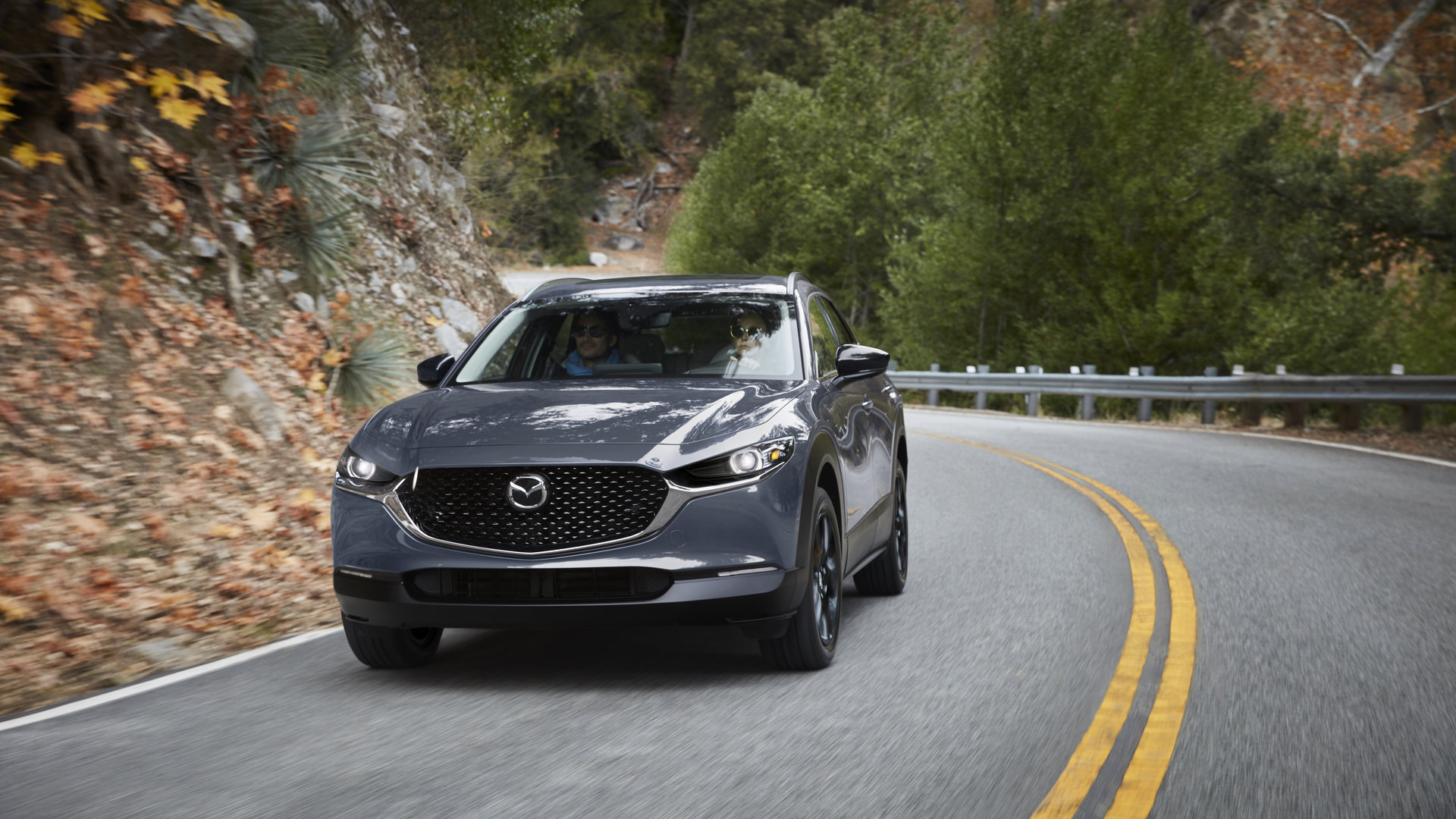
Choosing between the Mazda CX-30 and CX-5 usually comes down to one question: how much SUV do you actually need for your daily life in Quebec? Both wear the same Kodo design language and both put standard all-wheel drive under every trim, but they answer different everyday demands.
This comparison breaks down where the CX-30 and CX-5 diverge on cabin room, cargo, powertrain, and trim progression, so you can shortlist the one that matches your routine before you ever set foot in a showroom.
| Spec | CX-30 | CX-5 |
| Length | 4,395 mm | 4,690 mm |
| Wheelbase | 2,652 mm | 2,815 mm |
| Cargo (behind rear seats) | 572 L | 954 L |
| Max cargo (seats folded) | 1,280 L | 1,882 L |
| Ground clearance | 203 mm | 204 mm |
| Turning circle | 10.6 m | 11.2 m |
| Base engine | 2.5L I4, 186 hp / 186 lb-ft | 2.5L I4, 187 hp / 186 lb-ft |
| Drivetrain | Standard AWD | Standard AWD |
The CX-5’s extra 295 mm of length and 163 mm of wheelbase over the CX-30 show up directly in cargo numbers: 954 L behind the rear seats versus 572 L in the CX-30, and 1,882 L with the seats folded versus 1,280 L. That’s real room for hockey bags, strollers, or a family road trip.
The CX-5’s rear doors also open wide enough that larger child restraints can be installed without sliding or folding the front seat, a detail that matters for parents buckling kids in daily. The CX-30 keeps a tighter footprint by comparison, which trades outright volume for an easier vehicle to thread through parking garages and narrow city streets.
Neither cabin crowds the driver. The CX-30 offers 973 mm of headroom, while the CX-5 delivers 1,007 mm up front along with 1,058 mm of legroom and 1,462 mm of shoulder room, numbers that translate into noticeably more stretch-out space for taller passengers or long highway stints.
The CX-30 gives buyers a choice. The base 2.5L four-cylinder makes 186 hp and 186 lb-ft on regular fuel, enough for daily commuting without a second thought. Move up to the GT or GT Kuro and the optional 2.5L turbo steps in at 250 hp and 320 lb-ft on 93-octane fuel (227 hp and 310 lb-ft on regular), a genuinely quicker, more engaging setup for drivers who want that extra response off the line.
The CX-5 keeps it simple: one 2.5L four-cylinder across every trim, producing 187 hp and 186 lb-ft, paired with a 6-speed automatic. There’s no engine decision to make, just a straightforward, consistent driving character whether you’re in the GX or the fully loaded GT.
Both SUVs pair their engines with standard i-Activ AWD and G-Vectoring Control Plus, technology that shifts load between the tires through corners and on slick pavement, useful on the snow, rain, and gravel that make up a typical Quebec winter. The CX-30’s tighter 10.6 m turning circle makes it the easier of the two to spin around in a tight lot, while the CX-5’s 11.2 m circle reflects its larger, more stable stance for highway driving and loaded road trips.
The CX-30 ladder runs from GX through GS, GS Kuro, GT, and GT Kuro. The GX starts with an 8.8-inch touchscreen, a 7-inch instrument display, and an 8-speaker system. Step up to GS and the screen grows to 10.25 inches with wireless smartphone connectivity, and the GT Kuro Turbo tops the range with a 12-speaker Bose audio system alongside its turbocharged engine.
The CX-5 moves through GX, GS, and GT, with the Panoramic Roof and Premium packages available on the top trim. The GX pairs a 12.9-inch touchscreen with a 10.25-inch digital cluster, an 8-speaker system, and cloth upholstery. The GS upgrades to leatherette and cloth, and the GT brings leather, a 15.6-inch touchscreen, 4 USB ports, and 12 speakers.
The GT Premium Package on the CX-5 adds a meaningful jump in daily convenience:
That progression signals where each model is headed: the CX-30 layers on performance and audio as you climb the trims, while the CX-5’s higher trims lean into comfort tech and hands-free convenience built for family use.
If your days are mostly city errands, tight parking, and a shorter commute, the CX-30’s compact footprint, 10.6 m turning circle, and available turbo engine deliver an agile, premium-feeling small SUV without the bulk. It’s the pick for drivers who want Mazda’s driving feel in the smallest possible package.
If your household needs more passenger stretch-out room, a bigger cargo hold for gear, and easier child-seat installs, the CX-5’s larger cabin, 954 L of cargo space, and single, uncomplicated powertrain make it the more practical fit. It’s built for growing families and anyone who regularly hauls more than a couple of bags.
Both destinations share the same standard AWD, the same G-Vectoring Control Plus tuning, and the same Mazda driving character underneath, so neither buyer is settling for less engagement, just a different size for a different life.
The CX-30 and CX-5 give Quebec shoppers two paths inside the same Mazda lineup: one tuned for compact, agile daily driving, the other built around extra passenger and cargo room for family life.
Visit Planète Mazda in Mirabel to check rear-seat room and cargo space in person, then test drive the CX-30 or the CX-5 to see how each one handles your daily routes.